

An immune protein involved in DNA repair
Publié le 09/07/2025
The “Inflammasome and Cancer” team, led by Virginie Petrilli, has uncovered an unexpected role for NLRP3, a key immune molecule, in preserving the cell’s genetic material. This discovery offers new insights into DNA repair mechanisms.
Known until now for its role in infection response, the NLRP3 protein has been found to play an important role in a different process: DNA repair. A study by the CRCL team, published in Nucleic Acids Research, sheds light on how cells protect their genome from everyday damage.
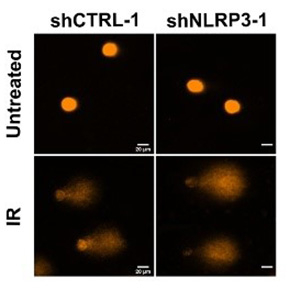
©D.Burlet
DNA and repair mechanisms
Our DNA faces thousands of damages every day, caused by external factors like UV radiation and by normal cellular processes. Among the most serious damages are double-strand breaks, where both strands of the DNA helix are cut. This is critical, as faulty repair can lead to mutations that cause cancer.
Cells rely on two main repair pathways to address these breaks. Homologous recombination (HR) is the most precise and requires a preparatory step called “resection,” where one damaged DNA strand is trimmed. The other pathway, non-homologous end joining (NHEJ), is faster but prone to errors.
NLRP3 beyond immune response
Researchers found that NLRP3 plays a role in the resection step. Previously studied for its immune functions, NLRP3 also promotes homologous recombination by helping the resection process, allowing faithful DNA repair.
Without NLRP3, homologous recombination becomes inefficient, and cells struggle to properly repair double-strand breaks. Cancer cells lacking NLRP3 are more sensitive to PARP inhibitors (PARPi), a class of drugs used against triple-negative breast cancer and ovarian cancer. These drugs target cells with impaired homologous recombination and lead them to cell death by blocking alternative repair pathways.
Key interaction with REV7 protein
The study also highlights an interaction between NLRP3 and REV7, a protein known to limit DNA resection via the Shieldin complex, which is part of the NHEJ pathway. NLRP3 binds directly to REV7, neutralizing its inhibitory effect on homologous recombination.
When both NLRP3 and REV7 are absent, cells recover their repair ability and become resistant to PARP inhibitors again. This is similar to what happens in cancer cells with mutations in the BRCA1 gene, a major player in homologous recombination.
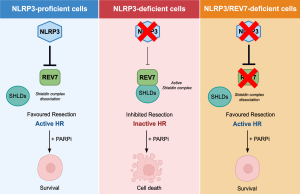
When DNA double-strand breaks occur, NLRP3 guides repair towards homologous recombination by binding REV7, a subunit of the Shieldin complex that inhibits HR. This allows cells to repair correctly and resist PARPi. Without NLRP3, REV7 forms the Shieldin complex that blocks HR, making cells sensitive to PARPi. If both NLRP3 and REV7 are missing, HR is restored and cells become resistant to PARPi. ©D.Burlet
New insights into treatment resistance
This research shows that NLRP3 supports the most accurate DNA repair pathway, helping maintain genome integrity and reduce mutation rates. Identifying this new regulator of DNA repair provides a better understanding of resistance to PARP inhibitors.