
Launch of the European SURPASS-TNBC Project: Advancing Precision Medicine for Triple-Negative Breast...
Publié le 14/10/2025
On October 14th, 2025, the Cancer Research Center of Lyon (CRCL) and Centre Léon Bérard (CLB) will host the kick-off meeting for SURPASS-TNBC, a collaborative European project funded under the EP PerMed program. This ambitious initiative aims to advance the understanding and treatment of triple-negative breast cancer (TNBC)—one of the most aggressive and hardest-to-treat forms of breast cancer.
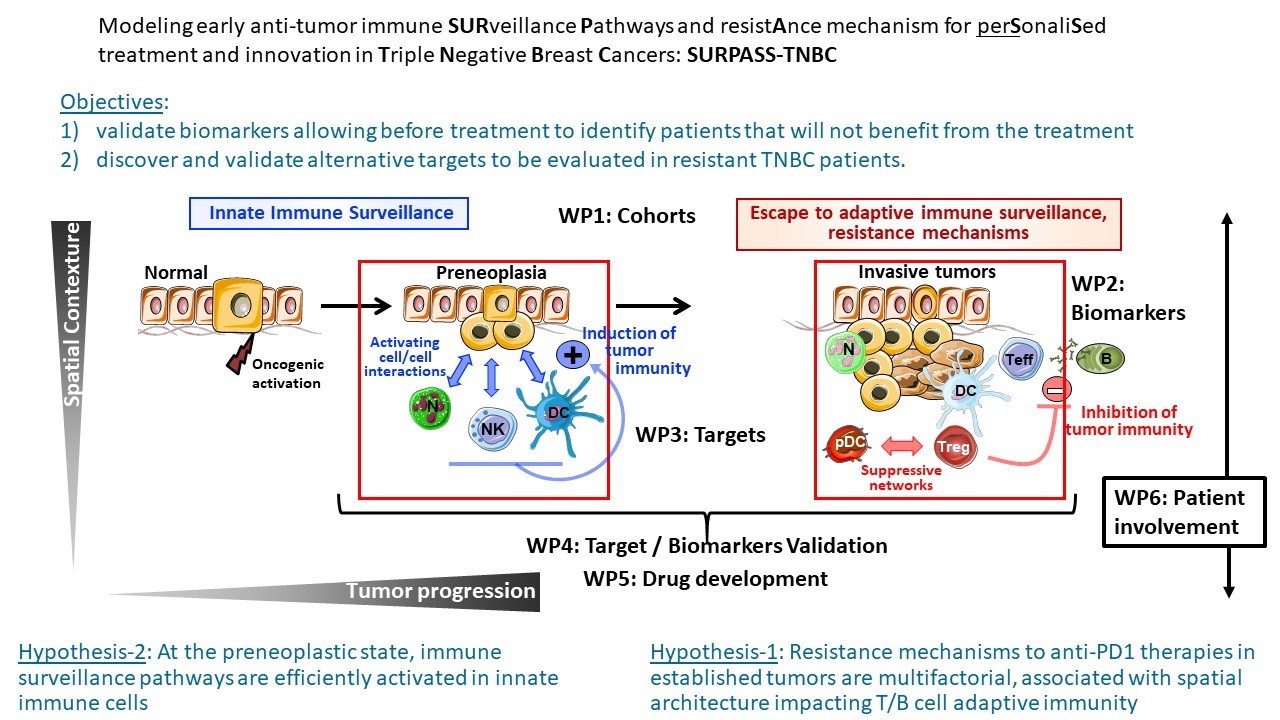
TNBC lacks hormone receptors and the HER2 target, leaving patients with very few targeted therapeutic options. While immunotherapy (IT) has opened new horizons, nearly one-third of patients do not respond to these treatments. SURPASS-TNBC seeks to overcome this challenge by identifying predictive biomarkers of resistance and developing innovative, personalized therapeutic strategies.
To reach this objective, the teams will leverage established patient cohorts and pursue two complementary approaches:
- Investigate molecular and immune mechanisms in IT-resistant and IT-responder patients.
- Decipher the evolution of immune surveillance mechanisms from preneoplastic stages (before tumor detection) to invasive TNBC, using state-of-the-art technologies and innovative computational biology methods.
The project is coordinated by Christophe Caux (Research Director, CRCL, CLB) and Olivier Tredan (Medical oncologist, CRCL, CLB) and brings together leading European partners:
- Institut Jules Bordet / Université Libre de Bruxelles (PI: Christos Sotiriou)
- OSE Immunotherapeutics (PI: Nicolas Poirier)
- University of Tübingen, Faculty of Medicine (PI: Manfred Claassen)
- Karolinska Institutet (PI: Jean Hausser)
- Cancer Patients Europe (PI: Antonella Cardone)
By combining cutting-edge research, clinical expertise and patient advocacy, SURPASS-TNBC is expected to pave the way for more effective, tailored treatments and significantly improve survival and quality of life for patients with this aggressive disease.