
Accueil > Research Teams > Cell States and Childhood Cancers
Cell States and Childhood Cancers
Objectives
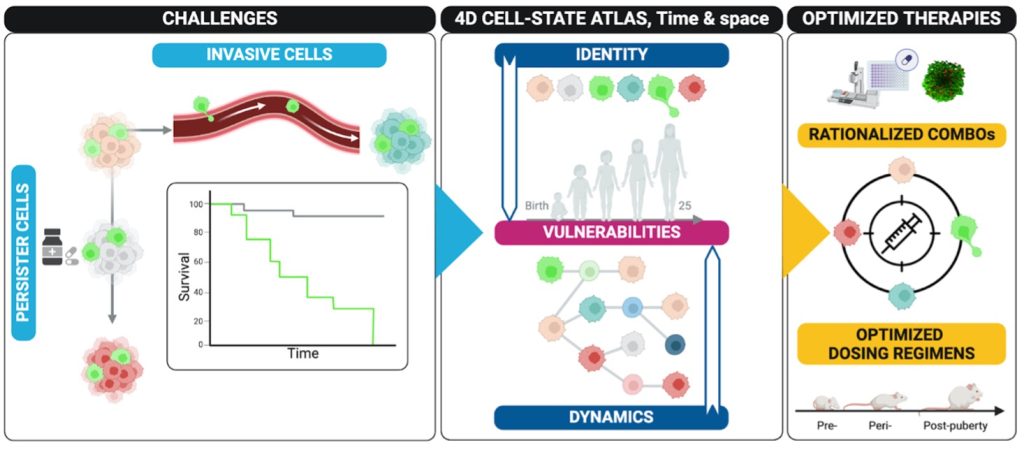
Graphical Abstract – Decoding and Targeting Aggressive Cell States in Pediatric and Youth Cancers: A Tumoroid-Based Multi-Omics Approach for Precision Therapy
Projects
- Leading Share4Kids: National platform gathering multi-omic data from hundreds of pediatric tumors, accessible to all researchers via a user-friendly interface developed with ADLIN-Science (€1M, INCa/MSD-AVENIR)
- Coordinating React4Kids network: 600+ researchers with training, doctoral collaborations, and annual conferences
- SouthROCK: INCa-certified Lyon-Marseille excellence center in pediatric oncology
-
Co-directors
Jean-Yves BLAY, PU-PH CLB/UCBL
jean-yves.blay@lyon.unicancer.frMarie CASTETS, DR Inserm
marie.castets@lyon.unicancer.frPrincipal investigators
Aurélie DUTOUR, CLB Researcher
aurelie.dutour@lyon.unicancer.frLaura BROUTIER, CRCN INSERM
laura.broutier@lyon.unicancer.frMartine CORDIER-BUSSAT, CRCN INSERM
martine.cordier-bussat@lyon.unicancer.frMarc BILLAUD, DR CNRS
marc.billaud@lyon.unicancer.fr
Members
Fundings
- Ligue Nationale Contre le Cancer – AAP Enfants, Adolescents et Cancer
- INCA – PediaMod 2022
- INCA – HRHG 2020
- PEDIAC
- Robert J. Arceci Innovation Award
National collaborations
- Eddy Pasquier – Centre de Recherche en Cancérologie de Marseille – Marseille
- Vanessa Ribes – Institut Jacques Monod – Paris
- Celio Pouponnot – Institut Curie – Orsay
- Samuel Maignan – Centre Oscar Lambret – Lille
- Cédric Maurange – Institut de Biologie du Développement de Marseille – Marseille
- Natacha Entz-Werle – Laboratoire de Bioimagerie et Pathologies – Illkirch
- Thomas Mercher – Institut Gustave Roussy – Villejuif
- Olivier Ayrault – Institut Curie – Orsay
- Daniel Orbach – Institut Curie – Paris
- Olivier Delattre – Institut Curie – Paris
- Sarah Watson – Institut Curie – Paris
- Raphael Rodriguez – Institut Curie – Paris
- Network React4Kids
International collaborations
- Matt Dun – University of Newcastle – Callaghan, Australie
- Luca Tiberi – University of Trento – Trento, Italie
- Jarno Drost – Princess Máxima Center – Utrecht, Pays-Bas
- Michael Meister – Princess Máxima Center – Utrecht, Pays-Bas
Publications
-
The Goldilocks paradox: when partial oncoprotein inhibition fuels metastasis in Ewing sarcoma
Marie Castets, Adrien Bertrand-Chapel & Jean-Yves Blay EMBO Molecular Medicine
-
Establishing a living biobank of pediatric high-grade glioma and ependymoma suitable for cancer pharmacology
Clémence Deligne, Arthur Tourbez, Flavie Bénard, Swann Meyer, Alexis Curt, Matteo Gianesello, Maud Hamadou, Léna Clavier, Claire Coquet, Charlotte Bocquet, Julia Tomine, Thomas Diot, Hermes Paraqindes, Virginie Marcel, Clément Berthelot, Justine Engel, Isabelle Rochet, Marc Barritault, Clara Savary, Nicolas Gadot, Valéry Attignon, Marjorie Carrere, Marc Billaud, Aurélie Dutour, Martine Cordier-Bussat, Pierre-Aurélien Beuriat, Alexandru Szathmari, Federico Di Rocco, Jean-Yves Blay, Luca Tiberi, Alexandre Vasiljevic, David Meyronet, Marie Castets, Pierre Leblond, Laura Broutier Neuro-Oncology
-
BMP2 and BMP7 cooperate with H3.3K27M to promote quiescence and invasiveness in pediatric diffuse midline gliomas
Paul Huchedé, Swann Meyer, Clément Berthelot, Maud Hamadou, Adrien Bertrand-Chapel, Andria Rakotomalala, Line Manceau, Julia Tomine, Nicolas Lespinasse, Paul Lewandowski, Martine Cordier-Bussat, Laura Broutier, Aurélie Dutour, Isabelle Rochet, Jean-Yves Blay, Cyril Degletagne, Valéry Attignon, Angel Montero-Carcaboso, Marion Le Grand, Eddy Pasquier, Alexandre Vasiljevic, Pascale Gilardi-Hebenstreit, Samuel Meignan, Pierre Leblond, Vanessa Ribes, Erika Cosset, Marie Castets eLife
A novel inhibitor of the mitochondrial respiratory complex I with uncoupling properties exerts potent antitumor activityAlaa Al Assi, Solène Posty, Frédéric Lamarche, Amel Chebel, Jérôme Guitton, Cécile Cottet-Rousselle, Renaud Prudent, Laurence Lafanechère, Stéphane Giraud, Patrick Dallemagne, Peggy Suzanne, Aurélie Verney, Laurent Genestier, Marie Castets, Eric Fontaine, Marc Billaud, Martine Cordier-Bussat Cell Death & Disease
Bone Morphogenic Proteins in Pediatric Diffuse Midline Gliomas: How to Make New Out of Old?Clément Berthelot , Paul Huchedé , Adrien Bertrand-Chapel, Pierre-Aurélien Beuriat, Pierre Leblond, Marie Castets International Journal of Molecular Sciences
-
Fusion-negative rhabdomyosarcoma 3D organoids to predict effective drug combinations: A proof-of-concept on cell death inducers
Clara Savary, Léa Luciana, Paul Huchedé, Arthur Tourbez , Claire Coquet, Maëlle Broustal, Alejandro Lopez Gonzalez 21, Clémence Deligne, Thomas Diot, Olivier Naret, Mariana Costa, Nina Meynard, Virginie Barbet, Kevin Müller, Laurie Tonon, Nicolas Gadot, Cyril Degletagne, Valéry Attignon, Sophie Léon, Christophe Vanbelle, Alexandra Bomane, Isabelle Rochet, Virginie Mournetas, Luciana Oliveira, Paul Rinaudo, Christophe Bergeron, Aurélie Dutour, Martine Cordier-Bussat, Aline Roch, Nathalie Brandenberg, Sophie El Zein, Sarah Watson, Daniel Orbach, Olivier Delattre, Frédérique Dijoud, Nadège Corradini, Cécile Picard, Delphine Maucort-Boulch, Marion Le Grand, Eddy Pasquier, Jean-Yves Blay, Marie Castets, Laura Broutier
Radiotherapy in bone sarcoma: the quest for better treatment option
Cell Reports MedicineMarie-Anaïs Locquet, Mehdi Brahmi, Jean-Yves Blay, Aurélie Dutour BMC Cancer
Identification of a miRNA multi-targeting therapeutic strategy in glioblastomaArthur Bassot, Helena Dragic, Sarah Al Haddad, Laurine Moindrot, Soline Odouard, Francesca Corlazzoli, Eliana Marinari, Alexandra Bomane, Augustin Brassens, Antoine Marteyn, Youssef Hibaoui, Tom J. Petty, Mounira Chalabi-Dchar, Louis Larrouquere, Evgeny M. Zdobnov, Noémie Legrand, Jérôme Tamburini, Hubert Lincet, Marie Castets, Mayra Yebra, Denis Migliorini, Valérie Dutoit, Paul R. Walker, Olivier Preynat-Seauve, Pierre-Yves Dietrich & Érika Cosset Cell Death & Disease
The TLR3 L412F polymorphism prevents TLR3-mediated tumor cell death induction in pediatric sarcomasJoseph Bisaccia, Swann Meyer, Adrien Bertrand-Chapel, Quentin Hecquet, Virginie Barbet, Bastien Kaniewski, Sophie Léon, Nicolas Gadot, Isabelle Rochet, Iveta Fajnorova, Pierre Leblond, Martine Cordier-Bussat, Nadège Corradini, Alexandre Vasiljevic, Marc Billaud, Cécile Picard, Laura Broutier, Cindy Gallerne, Aurélie Dutour, Jean-Yves Blay, Marie Castets cell death discovery
An OMA1 redox site controls mitochondrial homeostasis, sarcoma growth, and immunogenicityRichard Miallot, Virginie Millet, Yann Groult, Angelika Modelska, Lydie Crescence, Sandrine Roulland, Sandrine Henri, Bernard Malissen, Nicolas Brouilly, Laurence Panicot-Dubois, Renaud Vincentelli, Gerlind Sulzenbacher, Pascal Finetti, Aurélie Dutour, Jean-Yves Blay, François Bertucci, Franck Galland, Philippe Naquet Life Science Alliance
-
SMAD2/3 mediate oncogenic effects of TGF-β in the absence of SMAD4
Adrien Bertrand-Chapel, Cassandre Caligaris, Tanguy Fenouil, Clara Savary, Sophie Aires, Sylvie Martel, Paul Huchedé, Christelle Chassot, Véronique Chauvet, Victoire Cardot-Ruffino, Anne-Pierre Morel, Fabien Subtil, Kayvan Mohkam, Jean-Yves Mabrut, Laurie Tonon, Alain Viari, Philippe Cassier, Valérie Hervieu, Marie Castets, Alain Mauviel, Stéphanie Sentis, Laurent Bartholin Communications Biology
Complex Elucidation of Cells-of-Origin in Pediatric Soft Tissue Sarcoma: From Concepts to Real Life, Hide-and-Seek through Epigenetic and Transcriptional ReprogrammingClara Savary, Cécile Picard, Nadège Corradini, Marie Castets International Journal of Molecular Sciences
The Intricate Epigenetic and Transcriptional Alterations in Pediatric High-Grade Gliomas: Targeting the Crosstalk as the Oncogenic Achilles’ HeelPaul Huchedé ,Pierre Leblond, Marie Castets Biomedicines
-
H3.3K27M Mutation Controls Cell Growth and Resistance to Therapies in Pediatric Glioma Cell Lines
Andria Rakotomalala, Quentin Bailleul, Clara Savary, Mélanie Arcicasa, Maud Hamadou, Paul Huchedé, Audrey Hochart, Audrey Restouin, Remy Castellano, Yves Collette, Emma Dieny, Audrey Vincent, Pierre-Olivier Angrand, Xuefen Le Bourhis, Pierre Leblond, Alessandro Furlan, Marie Castets, Eddy Pasquier, Samuel Meignan Cancers
Future Match Making: When Pediatric Oncology Meets Organoid TechnologyVirginie Barbet and Laura Broutier Front. Cell Dev. Biol
Caspase-8 deficiency induces a switch from TLR3 induced apoptosis to lysosomal cell death in neuroblastomaMarie-Anaïs Locquet, Gabriel Ichim, Joseph Bisaccia, Aurelie Dutour, Serge Lebecque, Marie Castets, Kathrin Weber Scientific Reports
Aldehyde Dehydrogenase, a Therapeutic Target in Chordoma: Analysis in 3D Cellular ModelsMarie-Anaïs Locquet, Anne-Lise Dechaume, Paul Berchard, Lhorra Abbes, Daniel Pissaloux, Franck Tirode, Inès Ramos, Julie Bedoucha, Julie Valantin, Marie Karanian, Raul Perret, Olivier Gille, Jean-Yves Blay, Aurélie Dutour Cells
-
Loss of ANT1 confers a selective advantage to rhabdomyosarcoma tumor cells
Vial J*, Huchedé P*, Fagault S, Basset F, Rossi M, Geoffray J, Soldati H, Bisaccia J, Elsensohn MH, Creveaux M, Neves D, Blay JY, Fauvelle F, Bouquet F, Streichenberger N, Corradini N, Bergeron C, Maucort-Boulch D, Castets P, Carré M, Weber K, Castets M. Cell Death Discovery
MTOR signaling orchestrates stress-induced mutagenesis, facilitating adaptive evolution in cancerArcadi Cipponi, David L Goode, Justin Bedo, Mark J McCabe, Marina Pajic, David R Croucher, Alvaro Gonzalez Rajal, Simon R Junankar, Darren N Saunders, Pavel Lobachevsky, Anthony T Papenfuss, Danielle Nessem, Max Nobis, Sean C Warren, Paul Timpson, Mark Cowley, Ana C Vargas, Min R Qiu, Daniele G Generali, Shivakumar Keerthikumar, Uyen Nguyen, Niall M Corcoran, Georgina V Long, Jean-Yves Blay, David M Thomas Science
The immune landscape of chondrosarcoma – potential for therapeutic targeting of CSFR1+ macrophagesIseulys Richert, Anne Gomez-Brouchet, Corinne Bouvier, Gonzague Du Bouexic De Pinieud, Marie Karanian, Jean-Yves Blay, Aurélie Dutour Journal of Bone Oncology
Low expression of ANT1 confers oncogenic properties to rhabdomyosarcoma tumor cells by modulating metabolism and death pathwaysJ. Vial, P. Huchedé, S. Fagault, F. Basset, M. Rossi, J. Geoffray, H. Soldati, J. Bisaccia, M. H. Elsensohn, M. Creveaux, D. Neves, J. Y. Blay, F. Fauvelle, F. Bouquet, N. Streichenberger, N. Corradini, C. Bergeron, D. Maucort-Boulch, P. Castets, M. Carré, K. Weber & M. Castets Cell death discovery
-
Infiltrating Myeloid Cells Drive Osteosarcoma Progression via GRM4 Regulation of IL23
Maya Kansara; Kristian Thomson; Puiyi Pang; Aurelie Dutour; Lisa Mirabello; Francine Acher ; Jean-Philippe Pin; Elizabeth G. Demicco; Juming Yan; Michele W.L. Teng; Mark J. Smyth; David M. Thomas Cancer Discovery
LKB1 specifies neural crest cell fates through pyruvate-alanine cyclingRadu AG, Torch S, Fauvelle F, Pernet-Gallay K, Lucas A, Blervaque R, Delmas V, Schlattner U, Lafanechère L, Hainaut P, Tricaud N, Pingault V, Bondurand N, Bardeesy N, Larue L, Thibert C, Billaud M Science Advances
Detection of tumor ALK status in neuroblastoma patients using peripheral bloodCombaret V, Iacono I, Bellini A, Brejon S, Bernard V, Marabelle A, Coze C, Pierron G, Lapouble E, Schleiermacher G, Blay JY Cancer medicine
Caspase-8 deficiency induces a switch from TLR3-induced apoptosis to lysosomal cell death in neuroblastoma cell linesLocquet MA, Ichim G, Bisaccia J, Dutour A, Lebecque S, Castets M* and Weber K* In revision
-
Bcl-xl as the most promising Bcl-2 family member in targeted treatment of chondrosarcoma
Yvonne de Jong, David Monderer, Emeline Brandinelli, Morgane Monchanin, Brendy E. van den Akker, Jolieke G. van Oosterwijk, Jean Yves Blay, Aurélie Dutour & Judith V. M. G. Bovée Oncogenesis
Even the Warburg effect can be oxidized: metabolic cooperation and tumor developmentCordier-Bussat M, Thibert C, Sujobert P, Genestier L, Fontaine É, Billaud M Med Sci
The Ectodysplasin receptor EDAR acts as a tumor suppressor in melanoma by conditionally inducing cell deathVial J, Castets M Cell death and differentiation
-
Human primary liver cancer-derived organoid cultures for disease modeling and drug screening
Broutier L, Huch M Nature medicine
-
Description of the immune microenvironment of chondrosarcoma and contribution to progression
François A Simard, Iseulys Richert, Alexandra Vandermoeten, Anne-Valérie Decouvelaere, Jean-Philippe Michot, Christophe Caux, Jean-Yves Blay, Aurélie Dutour OncoImmunology
Culture and establishment of self-renewing human and mouse adult liver and pancreas 3D organoids and their genetic manipulationBroutier L, Andersson-Rolf A, Hindley CJ, Boj SF, Clevers H, Koo BK, Huch M Nature protocols
Targeting netrin-1/DCC interaction in diffuse large B-cell and mantle cell lymphomasBroutier L, [...], Vial J, [...], Castets M, EMBO molecular medicine
-
Detection of tumor ALK status in neuroblastoma patients using peripheral blood
Combaret V, Iacono I, Bellini A, Brejon S, Bernard V, Marabelle A, Coze C, Pierron G, Lapouble E, Schleiermacher G, Blay JY Cancer Medicine