

Endocrine resistance, methylation and breast cancer

Context
Breast cancer (BC) is a heterogeneous disease in which alterations in genes such as Estrogen receptor ERα, progesterone receptor (PR) and HER2 affect the clinical behaviour of the disease and the response of patients to targeted therapies. About 80% of primary breast tumors express ERα and endocrine therapy has led to a significant improvement in cell survival. However, 40% of patient are resistant to treatments. Furthermore, triple negative breast cancers (TNBC), that account for 15% of BC, are highly aggressive with rapid and frequent local and distant relapse. TNBC are mainly treated by chemotherapy. However, 20-30% of patients relapse and present metastatic incurable disease, so there is an urgent need to identify predictive biomarkers of response to adjuvant treatment and new targets in the adjuvant and metastatic settings. A recent surge of interest for other members of the nuclear receptor family such as androgen (AR) and glucocorticoid receptors (GR) is noteworthy. These receptors have opposite roles in ERα-positive and ERα-negative tumors, revealing an unanticipated level of complexity. Steroid receptors are associated with non-genomic actions but are mainly known to be transcription factors regulated by hormone binding that modulates transcription by recruiting coregulator proteins to DNA sequences in the genome that are enhancer and silencer elements controlling the expression of specific genes. Coregulators modulate local chromatin conformation and activate or inhibit recruitment and activation of RNA polymerase II. In another hand, transcriptional activity of steroid receptors and their coregulators is highly regulated by post-translational modifications as lysine or arginine methylation, involving enzymatic activities of lysine methyltransferases (KMTs) and arginine methyltransferases (PRMTs). However, these enzymes can also modify histones, adding another level of complexity. In addition, these enzymes are overexpressed in BC, associated with oncogenic activities and specific inhibitors of their catalytic activity make them promising therapeutical targets.
Objectives
Our team “Endocrine resistance, methylation and breast cancer” aims to decipher the molecular mechanism involved in resistance to different treatments in order to identify new therapeutical target and new drugs specific to different subtype of BC. Complementarity between researchers and clinicians is an undeniable asset to transfer the results obtained in the laboratory to patients.
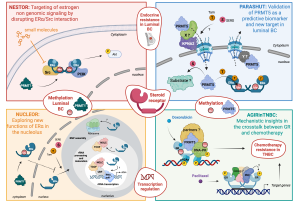
1) NESTOR: Innovative strategy to resensitize luminal BC to endocrine therapy by screening small molecules that block ERα/Src interaction.
Led by S. Sentis, O. Trédan and M. Le Romancer in close collaboration with S. Giraud, supervisor of the C3D platform, CRCL.
We previously demonstrated that the non-genomic complex containing ERα/Src/PI3K is involved in resistance to endocrine therapy (Poulard et al, 2012), by showing that ERα/Src and ERα/PI3K expression is associated with reduced patient survival (Jacquemetton et al, 2021). In addition, ERα/Src and ERα/PI3K expression is increased in PDX models with acquired resistance to Tam. We showed that a peptide disrupting ERα/Src interaction partially restores Tam sensitivity (Poulard et al, 2019). Using PDX models of luminal BC, we found that in tumors resistant to standard anti-estrogens, estrogen non-genomic signaling is still operative, highlighting that targeting this alternative pathway is crucial. However, we were unable to disrupt estrogen non-genomic signaling by inhibiting Src or PI3K (Jacquemetton et al, 2021), justifying investigations into other strategies. The aim of the NESTOR project is to screen for molecules inhibiting ERα/Src interaction, to impede activation of estrogen non genomic signaling.
2) PARASHUT: Validation of PRMT5 as a predictive biomarker and novel target in luminal BC.
Led by M. Le Romancer and O. Trédan
PRMT5, the major type II protein arginine methyltransferase (PRMT) performing symmetrical dimethylation possesses oncogenic properties and its expression is associated with a decreased patient survival in several cancers. So, selective inhibitors are being developed and tested by other in clinical trials. However, several publications reported that the role of PRMT5 differs according to its subcellular localization. Our team previously showed that in BC patients, high nuclear expression of PRMT5 is associated with an increased survival in the adjuvant setting (Lattouff et al, 2019).
More recently, the analysis of two independent BC cohorts revealed that the prognostic value of the expression of nuclear PRMT5 is restricted to patients treated with adjuvant Tam (but not with aromatase inhibitors), suggesting that a functional link between PRMT5 and ERα may exist. We found that in sensitive tumors to Tam, Tam induces PRMT5 nuclear translocation. In the nucleus, PRMT5 methylates ERα, a key event for the recruitment of corepressors impeding ERα transcriptional activity (Poulard et al, 2023). Conversely, in anti-estrogen resistant tumors PRMT5 remained localized in the cytoplasm, suggesting that modulating PRMT5 localization in the nucleus is essential for anti-estrogen efficacy. The aim of the PARASHUT project is to unveil the mechanism regulating PRMT5 nuclear shuttling to improve efficacy of anti-estrogens in luminal breast cancer.
3) NUCLEOR: Exploring new functions of ERα in the nucleolus.
Led by M. Le Romancer, JM Vanacker and S. Martinez.
Following a SILAC peptide screen investigating proteins differentially recognizing ERα methylated on R260 residue, we recently identified 3 new partners TCOF1, NOLC1 and UBF. These proteins are main regulators of ribosomal RNA. We validated these interactions in cellulo and found that ERα is localized in the nucleolus upon anti-estrogen treatment but not after estrogen treatment. The aim of the NUCLEOR project aims at understanding the new role of ERa in this nuclear structure and its impact on the response to anti-estrogens.
4) AGIRinTNBC: Mechanistic insights in the crosstalk between GR and chemotherapy.
Led by C. Poulard and B. Méry
GR has recently been associated with metastases formation and chemotherapy resistance in TNBC. In this context, we identified PRMT5 as a master coregulator of GR, independently of its enzymatic activity, allowing the recruitment of other coregulators facilitating the expression of GC-dependent target genes involved in cell migration (Nourredine et al, 2023).
Taxanes (i.e., paclitaxel) and anthracyclines (i.e., doxorubicin) are the most common chemotherapeutic agents used in TNBC patients. Using TNBC cell lines resistant to paclitaxel and doxorubicin established in our lab (Thibaut et al, 2024), we demonstrated that targeting GR resensitizes BC cells to chemotherapy. However, because GCs are essential to alleviate chemotherapy side-effects and play pleiotropic effects in homeostasis, the aim of AGIRinTNBC is to decipher the molecular mechanisms associated with GR involvement in resistance with a particular focus on transcriptional coregulators and their regulation of GR signaling via posttranslational modifications to propose new targets.
-
Co-direction :
Muriel Le Romancer, DR2 INSERM
Muriel.leromancer@lyon.unicancer.fr
0478782822Olivier Trédan, Médecin oncologue, PH, CLB
Olivier.tredan@lyon.unicancer.frCheney A, 1ème étage
Centre Léon Bérard