

Towards More Personalized Endometrial Cancer Care Through the SOFTER Project
Publié le 19/11/2026
How can we better predict the effectiveness of a treatment before it is even administered to a patient? This is the ambition of the SOFTER project, recently funded by the French National Research Agency (ANR) under the France 2030 programme. Led in particular by teams from the Lyon Cancer Research Center (CRCL), the project aims to develop a new generation of tumor-on-chip models to accelerate the advent of more personalized medicine for endometrial cancer.

@Adobe Stock/Elena
Better Understanding and Treating Endometrial Cancer
Endometrial cancer is currently one of the most common gynecological cancers. While many patients benefit from effective treatments, therapeutic options remain limited when the disease recurs or progresses. In addition, some innovative therapies, such as immunotherapy, are not effective for all patients.
To address this challenge, the SOFTER project aims to develop experimental models that more accurately reflect the biological reality of tumors, thereby accelerating the identification of effective treatments and fostering the development of personalized therapeutic approaches.
Recreating the Tumor Microenvironment on a Chip
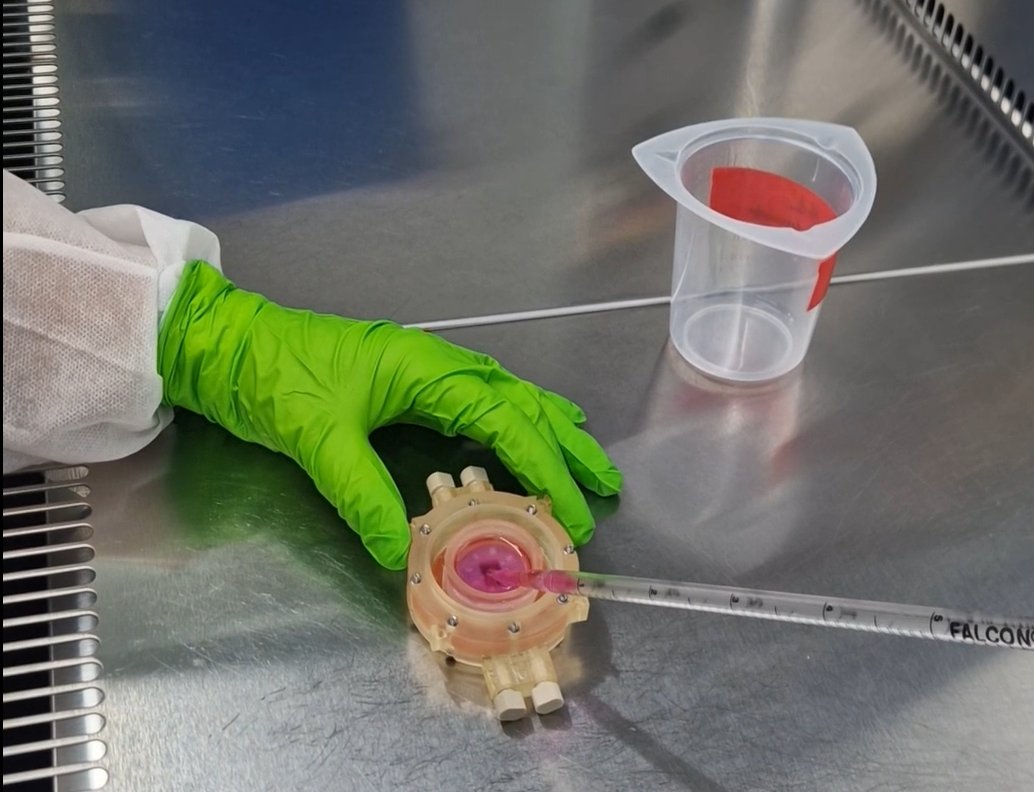
The tumor-on-chip model ready to receive patient-derived cells. © Estelle Bastien
At the heart of the project is the development of an innovative tumor-on-chip platform. This technology combines microengineering and cell biology to recreate, in the laboratory, the key features of the tumor microenvironment, including oxygen deprivation in specific tumor regions, the mechanical properties of tissues surrounding cancer cells, interactions with blood vessels, and the presence of immune cells.
This platform will enable researchers to reproduce conditions that closely resemble those found in the human body, making it possible to observe how individual tumors respond to treatments and to identify the most promising therapeutic approaches more rapidly.
Testing Treatment Responses Directly on Patient-Derived Cells
The project is based on a biobank of “mini-tumor” models derived from cells collected from patients treated at the Léon Bérard Center (CLB) and the Hospices Civils de Lyon (HCL). These models will be integrated into the chip platform to evaluate treatment responses in an environment that closely mimics physiological conditions.
By combining this approach with advanced artificial intelligence tools, SOFTER aims to become a powerful instrument for personalized medicine, enabling predictive and reproducible assessments of each patient’s response to therapy.
A Collaborative and Multidisciplinary Research Effort
Coordinated by Charlotte Rivière, Professor at Claude Bernard University Lyon 1 and researcher at both the CRCL and the Institut Lumière Matière (ILM), SOFTER brings together complementary expertise in microengineering, tumor biology, immunology, and oncology.
The consortium includes the Institut Lumière Matière (ILM), the Laboratory for Therapeutic Applications of Ultrasound (LabTau), and, within the CRCL, the team led by Jenny Valladeau-Guillemond and Stéphane Depil, as well as the ONCO-Chip and 3D-ONCO platforms. The project also involves clinicians from the Léon Bérard Center (CLB) and the Hospices Civils de Lyon (HCL), including Professor Isabelle Ray-Coquard (CLB) and Professor Charles-André Philip (HCL).
The teams will work with patient-derived samples, develop innovative microfluidic devices, and employ advanced imaging, single-cell analysis, and artificial intelligence technologies to identify the most relevant biomarkers of treatment response. One of the project’s unique features is its ability to generate clinical, molecular, biological, and mechanical data from the same patient samples.
Recognition of Scientific Excellence
The awarding of funding under the France 2030 PEPR MED-OOC programme highlights both the scientific excellence of the project and its strong potential for translation into precision medicine.
By bringing experimental models closer to the real-life conditions encountered in patients, SOFTER could help guide therapeutic decision-making more effectively and accelerate the development of new treatment strategies for endometrial cancer.