

Pancreatic cancer: an antibody developed at the CRCL shows promise in an early clinical trial
Publié le 22/04/2026
Affecting a growing number of patients, pancreatic cancer remains one of the most aggressive cancers due to the ability of cancer cells to resist conventional treatments such as chemotherapy. In this context, the “Apoptosis, Cancer and Development” team led by Patrick Mehlen, based at the Centre Léon Bérard, developed an antibody capable of blocking one of the key resistance mechanisms used by cancer cells. Named NP137, this antibody was evaluated in a phase 1 clinical trial coordinated by scientists from Université Grenoble Alpes and Grenoble Alpes University Hospital, under the leadership of Prof. Gaël Roth. This clinical trial was made possible thanks to the financial support of the Fondation ARC.
The results have just been published in the journal Nature¹.
NP137: an antibody designed to block a fundamental mechanism of resistance
In many cancers, certain tumor cells resist treatment by activating a process known as epithelial–mesenchymal transition (EMT), through which they rapidly change their shape and behavior, acquiring the ability to escape standard therapies. Research conducted for more than ten years by Patrick Mehlen’s team at the Centre Léon Bérard demonstrated that this process relies in part on the abnormal activation, during tumor progression, of a protein that is normally only present during embryonic development: netrin‑1.
This discovery led to the development, with the support of the startup Netris Pharma, of an antibody—NP137—capable of binding to netrin‑1 and preventing its interaction with its cellular receptor. By doing so, NP137 blocks the epithelial–mesenchymal transition of tumor cells. As a result, tumors become more sensitive to anticancer treatments.
A measurable benefit for patients
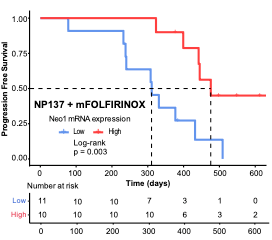
Disease progression in patients with pancreatic cancer treated with NP137 plus mFOLFIRINOX, according to high or low expression of the netrin‑1 receptor Neogenin‑1
Following promising initial data in animal models and in humans⁴, this drug candidate has now demonstrated its efficacy in a phase 1b clinical trial (LAPNET‑1) involving 43 patients with locally advanced, initially unresectable pancreatic cancer. Administered in combination with standard chemotherapy, NP137 significantly improved the duration of response to chemotherapy and, in some cases, prolonged overall survival compared with historical data from patients treated with chemotherapy alone.
This effect was particularly pronounced in patients whose tumors expressed the netrin‑1 receptor. In these patients, treatment was associated with an average extension of more than five months in progression‑free survival following chemotherapy.
While these results still need to be confirmed in a larger clinical trial (scheduled to begin at the end of 2026), they open up a promising therapeutic option for a cancer that is rapidly increasing in incidence and is expected to become the second leading cause of cancer‑related mortality by the 2030s–2040s. Ultimately, this therapeutic strategy could extend beyond pancreatic cancer, with potential applications in many other tumor types that share the same resistance mechanism.
1Netrin1 blockade alleviates resistance to chemotherapy in pancreatic cancer. Gael Roth et al. Nature, le 22 avril 2026.